
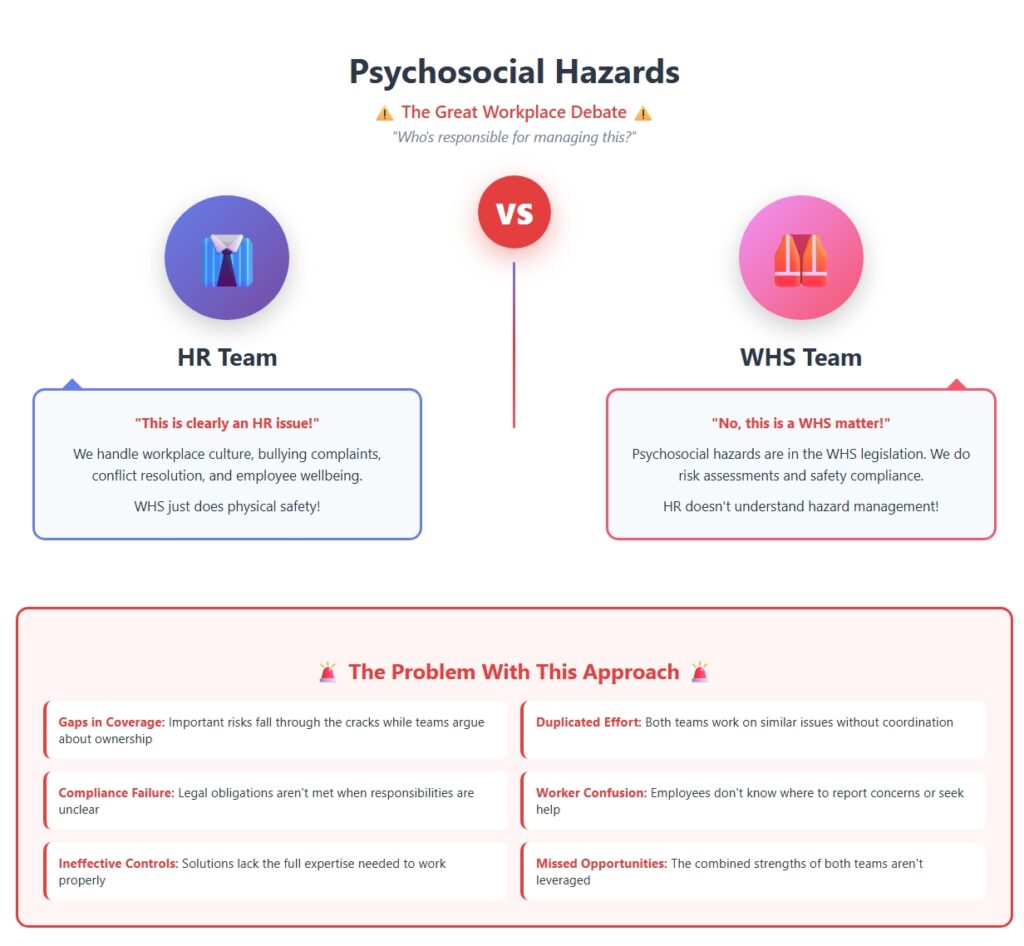
The Question That’s Causing Confusion in Australian Workplaces
Since the introduction of new psychosocial hazard regulations across Australian jurisdictions, one question keeps coming up: “Who owns this—HR or WHS?”
The answer? Both. And that’s exactly how it should be.
Why the Confusion Exists
Traditionally, Australian workplaces have operated with clear demarcation lines:
- WHS teams handle physical safety—machinery guards, PPE, hazardous substances, and incident investigations
- HR teams handle people matters—recruitment, performance management, employee relations, and workplace culture
Psychosocial hazards don’t fit neatly into either box. They’re fundamentally about psychological health and safety risks arising from work design, management practices, and workplace interactions. This means they require expertise from both domains.
What Are Psychosocial Hazards?
Under model WHS laws, psychosocial hazards include:
- Job demands (high or low)
- Low job control
- Poor support
- Lack of role clarity
- Poor organisational change management
- Inadequate reward and recognition
- Poor organisational justice
- Traumatic events or material
- Remote or isolated work
- Poor physical environment
- Violence and aggression
- Bullying and harassment
- Conflict or poor workplace relationships
Look at that list carefully. Some are clearly WHS territory (traumatic events, violence, physical environment). Others are unmistakably HR issues (organisational change, reward and recognition, conflict management). Most exist somewhere in between.
Why This Requires Collaboration
The WHS Perspective
WHS professionals bring critical capabilities:
- Risk assessment frameworks and methodologies
- Experience in systematic hazard identification
- Understanding of the hierarchy of controls
- Knowledge of legal compliance requirements
- Skills in incident investigation and root cause analysis
- Expertise in safety management systems
They understand how to identify, assess, and control workplace risks in a structured, systematic way. This is essential for meeting your legislative obligations under WHS Acts.
The HR Perspective
HR professionals bring equally essential expertise:
- People management knowledge and experience
- Understanding of workplace culture and dynamics
- Skills in conflict resolution and mediation
- Expertise in performance management systems
- Knowledge of organisational design and change
- Experience with employee relations and industrial instruments
They understand the human systems, relationships, and cultural factors that create or mitigate psychosocial risks. Without this insight, controls will miss the mark.
The Integration Imperative
Here’s the reality: you cannot effectively manage psychosocial hazards without both perspectives working together.
Consider a scenario: A WHS team conducts a psychosocial risk assessment and identifies “high job demands” as a significant hazard. What controls should be implemented?
- Reducing workload requires understanding of operational capacity and resource allocation (HR)
- Improving work design needs expertise in job analysis and role design (HR)
- Training managers to recognise overload requires understanding of capability frameworks (HR)
- But it also needs to be approached through a risk management lens (WHS)
- With proper consultation processes and control effectiveness measures (WHS)
Neither team can solve this alone.
Practical Integration Strategies
1. Joint Ownership of the Framework
Establish a psychosocial hazard management framework that:
- Is co-developed by HR and WHS
- Has shared accountability at executive level
- Includes joint governance mechanisms
- Uses integrated reporting to leadership
2. Collaborative Risk Assessment
When conducting psychosocial risk assessments:
- WHS leads the risk assessment methodology
- HR provides contextual expertise on organisational and human factors
- Both teams jointly interpret findings
- Controls are co-designed based on combined expertise
3. Shared Training and Capability Building
- Train both HR and WHS teams on psychosocial hazards
- Develop shared language and understanding
- Create cross-functional working groups
- Run joint manager training programs
4. Integrated Policies and Procedures
Your policies should reflect the integrated approach:
- Bullying and harassment policies link to both HR grievance processes and WHS incident reporting
- Change management procedures incorporate psychosocial risk assessment
- Performance management frameworks consider psychosocial safety
- WHS consultation includes HR representatives and vice versa
5. Clear Role Definition with Overlap
Rather than fighting over territory, define clear responsibilities while acknowledging necessary overlap:
WHS typically leads:
- Overall psychosocial risk assessment framework
- Legislative compliance monitoring
- Incident investigation (serious psychological injury)
- Safety management system integration
HR typically leads:
- Culture and engagement initiatives
- Manager capability development
- Workplace conflict resolution
- Organisational change management
Both collaborate on:
- Control design and implementation
- Workplace investigations (bullying, harassment)
- Training and awareness programs
- Monitoring and review processes
The Legal Imperative
This isn’t just good practice—it’s increasingly a legal requirement.
Under WHS legislation, Person Conducting a Business or Undertaking (PCBUs) have duties to eliminate or minimise psychosocial risks so far as is reasonably practicable. This requires:
- Systematic identification of hazards
- Assessment of risks
- Implementation of appropriate controls
- Regular review and monitoring
You cannot meet these obligations if HR and WHS are working in silos. The complexity of psychosocial hazards demands integrated expertise.
Common Pitfalls to Avoid
1. The “HR Owns It” Trap
Some organisations default psychosocial hazards entirely to HR because “it’s people stuff.” This fails because:
- HR may lack risk assessment expertise
- WHS obligations are not met
- Controls aren’t systematically evaluated
- Physical and psychosocial safety become disconnected
2. The “WHS Owns It” Trap
Alternatively, treating psychosocial hazards as purely WHS issues fails because:
- WHS teams lack organisational design expertise
- Root causes in culture and management aren’t addressed
- Controls feel disconnected from day-to-day people management
- HR capability to address issues isn’t leveraged
3. The “Everyone Owns It” (No One Owns It) Trap
Vague shared ownership without clear coordination leads to:
- Duplicated effort
- Gaps in coverage
- Confused managers and workers
- Ineffective controls
Making It Work: A Case Study Approach
Let’s look at how integrated management works for a common psychosocial hazard: workplace bullying.
WHS contribution:
- Include bullying as a hazard in risk registers
- Apply hierarchy of controls to prevention strategies
- Monitor lagging indicators (injury claims, incidents)
- Ensure compliance with WHS legislation
HR contribution:
- Develop and communicate behavioural standards
- Train managers on prevention and early intervention
- Provide support services and case management
- Address performance or conduct issues with alleged perpetrators
- Monitor leading indicators (culture surveys, exit interviews)
Joint activities:
- Co-design the bullying and harassment policy
- Conduct incident investigations using systematic methodology
- Deliver joint training to managers and workers
- Collaborate on workplace investigations
- Review effectiveness of controls together
- Report jointly to leadership on trends and actions
The Bottom Line
Psychosocial hazards sit at the intersection of workplace health and safety and people management. They cannot be effectively managed by either HR or WHS working alone.
The organisations that will succeed are those that:
- Embrace the overlap rather than fighting about territory
- Leverage the expertise from both functions
- Create integrated systems that reflect the complexity of these hazards
- Hold joint accountability for outcomes
This isn’t about HR doing WHS’s job or vice versa. It’s about recognising that psychosocial hazards require a genuinely integrated approach drawing on the best of both disciplines.
Getting Started
If your organisation is still debating who owns psychosocial hazards, here’s your action plan:
- Stop debating ownership and start planning collaboration
- Bring HR and WHS leaders together to map current responsibilities and identify gaps
- Co-develop a framework that leverages both teams’ expertise
- Pilot an integrated approach on one psychosocial hazard (e.g., bullying or high job demands)
- Measure effectiveness and refine your model
- Scale across all psychosocial hazards
The regulatory focus on psychosocial hazards isn’t going away. In fact, it’s intensifying. Organisations that break down silos between HR and WHS will be better positioned to create genuinely psychologically safe workplaces.
Need Help Integrating Your Approach?
At WorkRight Advisory, we help organisations develop integrated psychosocial hazard management frameworks that leverage both HR and WHS expertise. Our practical approach ensures you meet your legal obligations while building genuinely safer workplaces.
Contact us for:
- Psychosocial risk assessments
- Policy and procedure development
- HR and WHS capability building
- Manager training programs
- Ongoing compliance support